The Viper's Bugloss species or Tajinastes of Tenerife in the Canary Islands

The Viper's Bugloss or Tajinaste
There is a colourful family of strange plants known as species of Viper's Bugloss, or Tajinastes, as they are called in Spanish.Various types found in the Canary Islands are also known as Tower of Jewels, referring to their height and the many flowers they produce.
Some of them are very tall and impressive, whilst others are small and easily missed. Some are endangered species that are very rare in the wild and others grow as invasive weeds.
Viper's Bugloss species
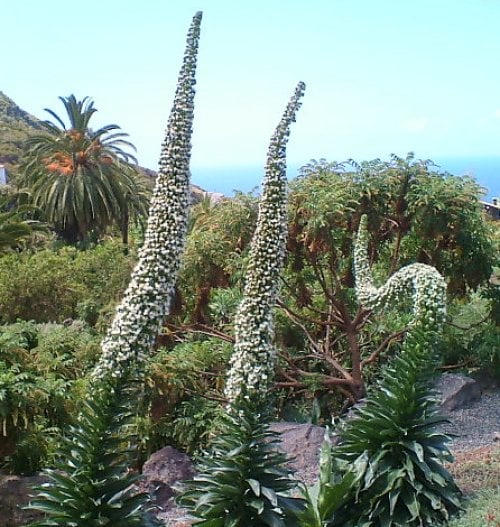
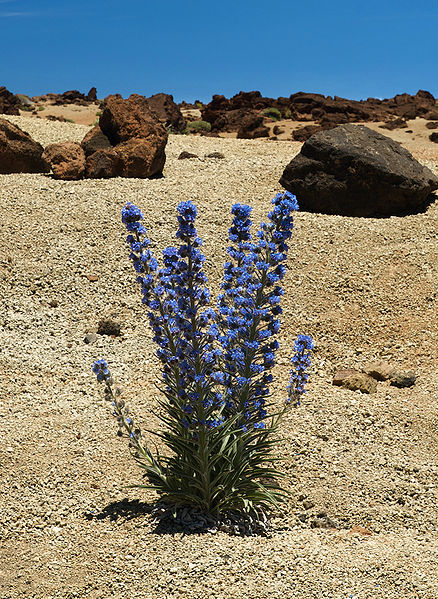
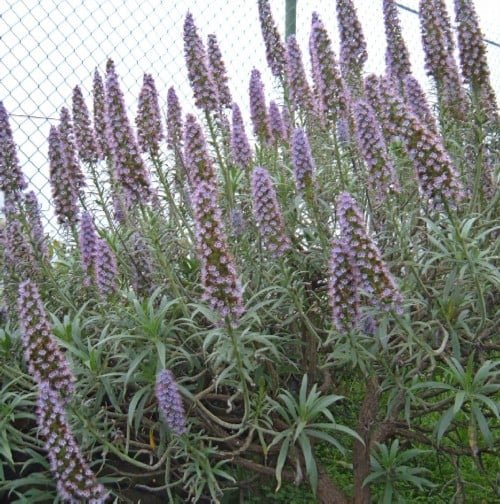
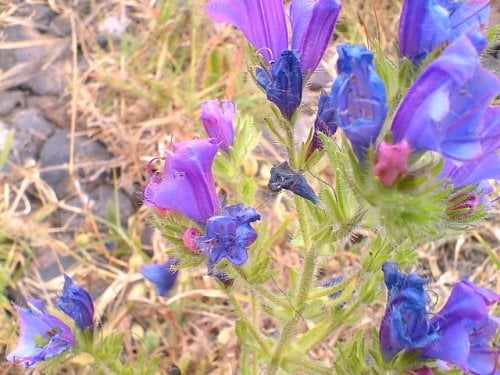
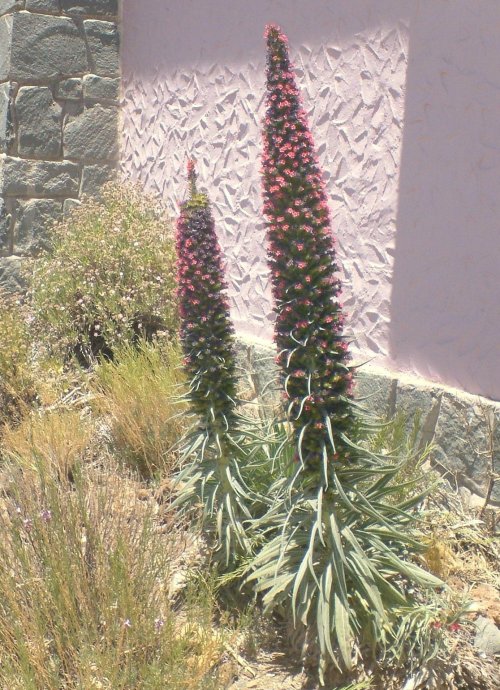
The many colourful Viper's Bugloss species
All the Viper's Bugloss species are pollinated by bees and butterflies and these insects find them very attractive as sources of nectar. Many of the species produce a fantastic quantity of seeds running into thousands per flowering spike.
In view of this, it is surprising to find that some of the larger and more spectacular species like Echium wildpretii, the Red Viper's Bugloss, and Echium simplex, a white species, are confined to only a few locations in Tenerife. The former grows high up on Mt Teide and also in the area of the mountain village of Vilaflor, whilst E. simplex is only known from a few cliff faces and rocky coastlines in the north of the island.
Echium auberianum is a smaller species, though very pretty still, but is also very rare indeed, and only found in small numbers in the sub-alpine parts of Mt Teide.
E. wildpretii and E. simplex often get planted in parks and gardens, and the even taller E. pininana is another endangered species in the wild that only grows in some mountain laurel forests on the island of La Palma. It reaches up to 4m in height and its blue flowers attract plenty of bees and other pollinating insects.
Because of its spectacular appearance it has become a popular ornamental garden flower and is grown in gardens in the southern counties of the UK and elsewhere in the world. The seeds are often available via nurseries and specialist flower-suppliers.
Whilst these species already mentioned are very rare in the wild, the equally pretty but much smaller E.plantagineum is an invasive weed that rapidly colonises fields, farmland and wasteground. Why some species of Echium do so well and others are endangered is a bit of a botanical mystery. Some species have colonised the world as invasive weeds, whilst others are only found in small populations in restricted habitats in a couple of places, such as Mt Teide on Tenerife.
E. virescens is another massive species that forms branched bushes up to 2m high and about that across. It is fairly common in some mountainous and forested areas of Tenerife in both the north and south of the island.
E.giganteum is another large species, as its name suggests. It has white flowers and grows into a bush some 2.5m in height. It is fairly common in some areas of the north and also gets cultivated in gardens and public borders because of its ornamental qualities.
Many of the Viper's Bugloss species grow from a central rossette of leaves, which in the second year produces a flowering spike. Others are perennial and form bushes. Some species are annuals. All tend to have rough foliage and stems and produce tiny hard nut-like seeds.
The Viper's Bugloss species are all in the Borage family, the Boraginaceae , which contains many plants that are valued as herbs and as flowers.
The seeds are known to be very high in gamma-linoleic acid or GLA, which is a very useful and popular health supplement. The leaves of the plants are also used in herbal medicine as infusions to treat headaches, fevers and coughs, as well as for their diuretic properties.
In the UK and many other parts of the world there is a blue Viper's Bugloss (E.vulgare ) that tends to grow in sand dunes and waste ground. It can become an invasive weed like E. plantagineum , but it is a very pretty one.
The red-flowered E. wildpretii with its attractive but strange-looking spikes has become a symbol of Tenerife and is often seen on postcards, in guidebooks and in paintings of the island.
This species is adapted to a very specialised habitat, which gets icy cold in winter and at night and baking hot by day, as well as being subjected to summer droughts. Mt Teide is the highest mountain in all of Spain and the Tajinaste Rojo (red) grows best high up on the rocky volcanic mountain slopes. To see it in full bloom is an unforgettable sight.
Echium species in Wikipedia
© 2009 Steve Andrews
Related
The mysterious pyramids of Tenerife in the Canary Islands
Prickly Pear cacti grow on Tenerife in the Canary Islands
Endangered Canary Islands wildflowers: Tenerife's Parrot's Beak is almost extinct in the wild
Basic Facts about the Canary Islands
The Dragon Tree of the Canary Islands - a Plant Survivor From Prehistoric Times